
Change is hard at first, Messy in the middle and Gorgeous at the end.
Rohit Sharma (The Monk Who Sold His Ferrari)
As a Design Thinking facilitator, I have applied Design Thinking methodologies to address a range of organizational challenges, including:
- Catalyzing innovation in product and service experiences
- Establishing clarity and alignment on complex challenges such as new business models, change management, and process design
- Developing a prioritized, actionable, and measurable roadmap for key initiatives
Design Thinking is a highly interactive, hands-on approach that thrives on cross-functional collaboration. As a facilitator, my approach is to assemble and engage diverse teams early in the process. This ensures alignment on the vision and a shared understanding of key challenges from the outset. Collaborative engagement also fosters the inclusion of broad perspectives and diverse ideas – essential ingredients for effective and innovative design solutions.
Design Thinking Model
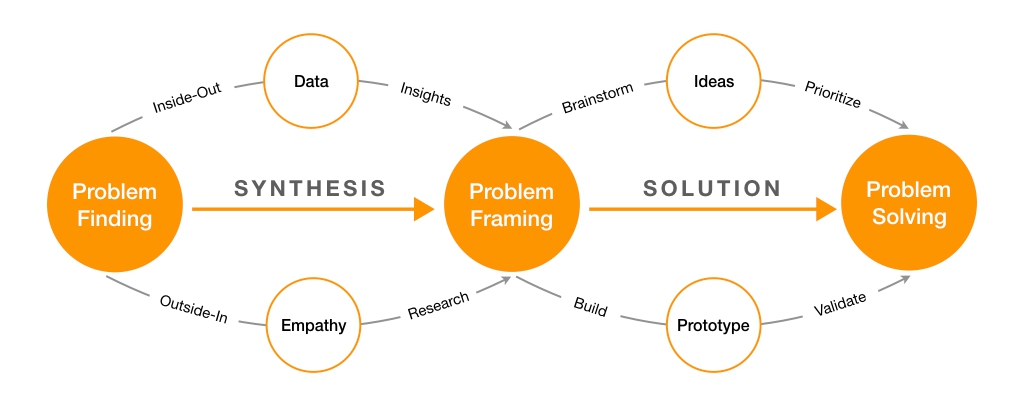
I collaborate with cross-functional teams across three key phases of problem-solving:
- Problem Finding – Leveraging exploratory research and divergent thinking to understand the user context, purpose, pain points, and opportunities for design intervention.
- Problem Framing – Applying actionable insights and convergent thinking to reframe the problem and develop a strong design hypothesis.
- Problem Solving – Using a well-articulated problem statement and divergent thinking to explore the solution space, prototype ideas, validate with users, and refine solutions based on feedback.
This structured approach ensures that we deeply understand the problem, define it effectively, and develop solutions that are both innovative and user-centered.
Workshop Facilitation
To engage the team and drive the process, I plan a series of workshops at various stages of the Design Thinking process. Cross-functional teams bring insights into business, user needs, and technology. Together, they refine the problem statement, contribute to ideation, address constraints, and prototype solutions. These teams are action-oriented, ensuring rapid iteration through a continuous validation loop.
Workshops typically range from half a day to two days in duration. While Design Thinking methods and tools remain consistent, the workshop format varies based on the objective. I follow a flexible and scalable structure, broadly covering the following agenda:
- Assess and Align – Establish a shared understanding, define the purpose, and focus on the why.
- Ideate and Prioritize – Use divergent thinking to explore the solution space, then converge using prioritization frameworks, focusing on the what.
- Vision and Roadmap – Define a clear vision, establish success criteria, align on the roadmap, and determine next steps, focusing on the how.
This structured yet adaptable approach ensures effective collaboration, alignment, and momentum throughout the design process.
Here are some examples of organizational challenges I have helped address through the Design Thinking methodology:
- How might we support communities in recovering from natural disasters?
- How might we align our corporate social responsibility (CSR) initiatives to empower women business owners and create new growth opportunities for the bank?
- How might we structure wealth management operations to enhance the effectiveness and expertise of wealth advisors in client interactions?
- How might we develop a partner program for premium auto dealerships to differentiate our brand as a preferred partner and lender?
- How might we align IT priorities and budget with the organization’s growth strategy?
- How might we engage top talent within the organization to solve challenges faced by nonprofit organizations?
Measuring the impact of Design Thinking
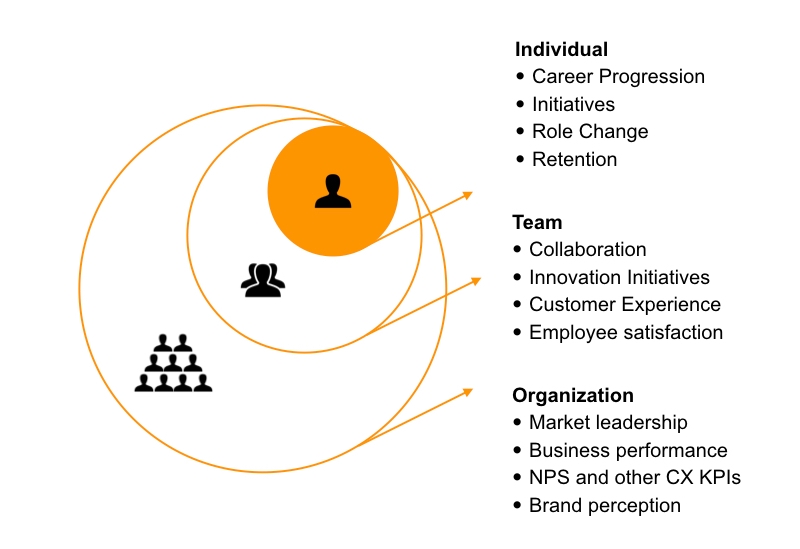
Design Thinking is a cornerstone of an agile and innovative organization. I view it as a critical capability that should be deeply integrated into talent and leadership development efforts. The return on investment (ROI) of Design Thinking can be measured at various levels across an organization, ensuring its effectiveness in driving meaningful change and innovation.
Read about my approach to Leadership and Design Process.
See End-to-end Case Studies where I have applied Design Thinking methodologies to projects.
Learn about my workshops on Design Thinking for Youth
 abhijit.design